A truck accident in Georgia is not investigated the same way as a regular car accident. Commercial trucks are governed by federal safety regulations, monitored by onboard electronic computer systems, insured through multiple corporate layers, and often operated by several companies that share responsibility.
When a truck crash happens on I-75, I-16, I-85, or any Georgia highway, key evidence can disappear fast, sometimes within hours. A proper truck accident investigation determines fault, preserves critical data, identifies every responsible party, and ultimately influences the value of the injury claim.
If you’ve been hurt in a commercial truck accident, understanding the investigation process and why hiring a Georgia truck accident lawyer early can make a huge difference.
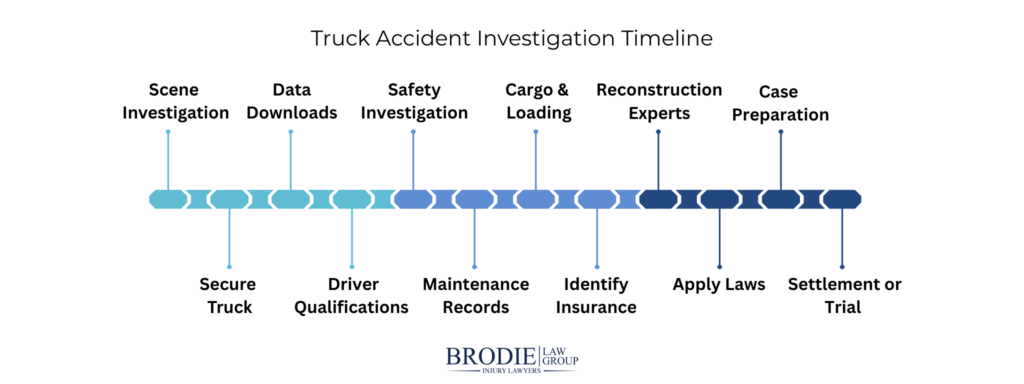
Step 1 – Investigation and Preserving the Crash Scene
The first priority after a Georgia truck accident is securing and documenting the scene before important evidence is lost. Traffic flow, cleanup crews, and weather can erase important details within minutes.
Truck accident investigators look for:
- Skid marks and yaw marks
- Debris patterns
- Vehicle resting positions
- Roadway gouges
- Weather and visibility
- Signs of rollover or cargo spills
These details above can help crash reconstruction experts determine speed, braking, evasive action, and the overall sequence of events.
Early scene preservation also prevents spoliation, the destruction of evidence, which can result in court sanctions or adverse jury instructions against the trucking company.
To read more about why early evidence matters, visit our guide on spoliation of evidence in truck accident cases.
Step 2 – Securing the Truck and Trailer Before Repairs Begin
The truck and trailer contain some of the most important evidence. Trucking companies often rush to repair, move or unload a truck and trailer. Georgia truck accident attorneys move quickly to stop the trucking company from repairing, moving, or altering the vehicle so it can be examined in detail.
Important trucking components examined include:
- Braking systems
- Tires and wheels
- Steering mechanisms
- Underride guards
- Exterior lighting and reflectors
- Cargo securement devices
The Federal Motor Carrier Safety Administration, under FMCSA Part 396, requires motor carriers to systematically inspect, maintain, and repair equipment and to retain maintenance records for defined periods. Mechanical failures, such as out-of-adjustment brakes or worn tires, may indicate violations of these rules and support direct negligence claims.
If the truck is repaired too soon, evidence of mechanical failure or improper cargo loading could be lost forever.
Step 3 – Downloading ECM, EDR, and Telematics Data
Modern commercial trucks record enormous amounts of pre- and post-crash computer data. This information is objective and is often important in proving proof of what happened.
Common sources include:
- ECM (Engine Control Module)
- EDR (Event Data Recorder)
- ELD (Electronic Logging Device) logs
- GPS tracking systems
- Telematics platforms (Omnitracs, Samsara, etc.)
These systems may capture:
- Pre-impact speed
- Brake application
- Throttle position
- Hard braking events
- Steering inputs
- Hours-of-Service logs
- Route and location history
- Mechanical fault codes
Much of this electronic data, or EMC/black box data, is automatically overwritten in days and carriers may only keep certain records for six months unless placed on litigation hold, so attorneys must send immediate preservation letters.
Our article on driver fatigue and Hour-of-Service violations explains how electronic evidence can be used to help prove negligence.
Step 4 – Reviewing the Truck Driver’s Background and Qualification File
Federal law requires trucking companies to maintain a detailed Driver Qualification File (DQF). Attorneys examine this file to help determine whether the driver was properly trained and eligible to operate a commercial vehicle.
Key information reviewed includes:
- Commercial driver’s license status
- Hours-of-Service compliance
- Drug and alcohol test results
- Safety training records
- Prior crashes or violations
- Disciplinary history
- Cell phone use at the time of the crash
Motor carriers must also annually review each driver’s record, obtain new MVRs, and verify continued qualification. Gaps in employment history, missing employer responses, or inadequate medical certifications often show negligent hiring or retention.
Many truck accidents can be linked to unsafe hiring practices by trucking companies. Learn more about why this can be important in our article on negligent hiring in trucking cases.
Step 5 – Investigating the Trucking Company
A trucking company’s safety practices often plays a major role in a truck crash. Investigators review:
- Hiring and training practices
- Background checks
- Safety monitoring programs
- Hours-of-Service enforcement
- Vehicle maintenance and inspection procedures
- Safety rating and FMCSA compliance
If a company ignores safety requirements or operates with a poor safety rating, liability may increase significantly. For example, a “conditional” or “unsatisfactory” federal safety rating, or high BASIC scores under the CSA/SMS system, may indicate systemic safety failures and support corporate negligence claims.
For more information, see our article on how to check a trucking company’s safety record.
Step 6 – Reviewing Maintenance, Repair, and Inspection Records
Mechanical failure is one of the common factors of truck accidents in Georgia. Accident attorneys secure and review:
- Brake and tire inspection logs
- Daily DVIR reports
- Annual FMCSA inspections
- Repair invoices and logs
- Diagnostic fault code history
- Deferred maintenance notes
FMCSR requires carriers to maintain detailed maintenance files for every commercial vehicle, and inadequate inspection or repair procedures can support claims for negligent maintenance.
These documents often reveal problems that are easy for truck companies to hide, unless a truck accident lawyer knows where to look to uncover these inspection records.
Step 7 – Investigating Cargo Loading and Securement
Unsafe or improper cargo loading can lead to rollover crashes, jackknifes, and shifting-load collisions in Georgia. These issues are common when multiple companies are involved in the freight chain.
Investigators review:
- Load sheets
- Bills of lading
- Weight tickets
- Securement documentation
- Warehouse and shipper logs
- Broker and shipper communications
Shippers, brokers, or warehouse facilities may share in liability if the cargo was improperly secured.
If the trailer was sealed before pickup, the shipper is often presumed to have performed or controlled the loading. Improper loading may establish shipper or broker liability.
Step 8 – Identifying All Liable Companies and Insurance Policies
Truck accidents often involve multiple entities:
- The driver
- The trucking company
- A trailer owner
- A freight broker
- A shipper
- A warehouse
- A maintenance contractor
Each party may have:
- Primary liability insurance policies
- Excess coverage
- Umbrella coverage
Many cases also involve “statutory employment” or “lease liability,” where a motor carrier is legally responsible for the actions of a leased operator or owner-operator running under its authority, even if the carrier claims the driver was an independent contractor.
Finding all the available layers of trucking insurance is one of the most important parts of maximizing a Georgia trucking accident claim where injuries are often very severe and damages can easily be over $1 million.
Step 9 – Working with Crash Reconstruction and Industry Experts
Reconstruction experts analyze the physical and digital evidence to determine how the crash happened. Their reports are essential in settlement negotiations and litigation.
Experts examine:
- Vehicle dynamics
- Impact angles
- Speed calculations
- Braking timelines
- Lane positions
- Cargo movement
- Mechanical integrity
These expert reports are vital in settlement negotiations and courtroom testimony to help establish liability for the truck accident.
Step 10 – Applying Federal & Georgia Law to Establish Liability
Once evidence is gathered, attorneys compare it to:
- FMCSA safety regulations
- Georgia traffic statutes
- Cargo securement rules
- Hours-of-Service standards
- Federal maintenance regulations
Georgia courts allow FMCSR violations as evidence of negligence. Because Georgia also adopts the FMCSR for most intrastate trucking, these rules can often apply even when the truck was not crossing state lines.
Violations often strengthen an injury claim and can significantly increase the value of an injury case.
Step 11 – Preparing the Case for Settlement or Trial
A fully investigated truck accident case allows attorneys to properly:
- Calculate medical damages
- Document long-term care needs
- Evaluate lost wages and earning capacity
- Prepare expert reports
- Submit settlement demand packages
- Negotiate with multiple insurers
- File suit if necessary
Where evidence shows reckless hiring, regulatory violations, or destruction of evidence, punitive damages may also be pursued under Georgia law.
Because truck accident claims require specialized knowledge and a detailed, multi-step investigative process, having the right legal team matters. If you’re unsure whether legal representation is necessary, our post on whether you need a lawyer after a truck accident explains how early legal involvement can significantly strengthen your case.
What to Do After a Truck Accident in Georgia
To protect your case:
- Seek immediate medical treatment
- Photograph the vehicles, damage, and scene
- Get witness names and contact information
- Preserve any dashcam or video footage
- Avoid giving statements to insurance companies
- Contact a Georgia truck accident attorney as soon as possible
Contact Brodie Law Group: Georgia Truck Accident Attorneys
Truck accident cases require fast action, detailed investigations, and experience handling:
- ECM and EDR downloads
- Corporate safety investigations
- Cargo loading failures
- Maintenance violations
- Fatigue and Hours-of-Service issues
- Multi-defendant litigation
The Brodie Law Group knows how to uncover hidden evidence, identify every liable party, and pursue the full compensation injured victims deserve. Speak with a Georgia truck accident lawyer today by calling (478) 239-2780 or fill out our accident contact form.