
FMCSA Part 396 is the section of the Federal Motor Carrier Safety Regulations that governs how commercial carriers inspect, repair, and maintain their vehicles. It forms the backbone of national truck safety standards and requires every truck on the road to be mechanically sound before, during, and after operation.
In Georgia, these rules also apply broadly because the state has adopted federal maintenance regulations for most intrastate carriers as well as those operating across state lines. For an overview of how different FMCSA violations in Georgia truck accident cases may help prove negligence, visit our full FMCSA violations guide.
To learn how Georgia truck accident claims work, including liability, evidence preservation, and compensation, visit our Georgia truck accident lawyer page.
Purpose of Part 396
The goal of Part 396 is straightforward: to prevent mechanical failures that lead to catastrophic truck crashes. The regulation requires motor carriers to establish a systematic inspection, repair, and maintenance program that operates continuously, not just when a driver happens to notice something wrong.
These standards are designed to prevent the most common mechanical failures documented in Georgia truck crash investigations, including:
- Braking violations
- Tire blowouts and wheel failures
- Steering and suspension defects
- Lighting and electrical problems
FMCSA Part 396 requires commercial vehicles to be kept in safe operating condition at all times.
Who Must Comply With Part 396?
Part 396 applies to virtually every individual or entity responsible for placing a commercial truck on the road.
That includes:
- Motor carriers, whether operating interstate or intrastate within Georgia
- Owner-operators managing their own equipment
- Leasing carriers responsible for the safe condition of leased vehicles
- Maintenance contractors hired to perform repairs or inspections
- Prior owners when negligent maintenance contributes to a crash
- Mechanics and inspectors performing DOT-required inspections or repairs
Because Georgia applies federal maintenance rules to most in-state carriers, these obligations extend to local freight companies, agricultural haulers, construction fleets, and other businesses that operate commercial vehicles within state lines.
Georgia Has Adopted FMCSR Maintenance Rules for Intrastate Carriers
Even trucking companies that operate solely within Georgia must comply with federal maintenance rules because Georgia has adopted the FMCSRs for most intrastate commercial carriers. That means a company hauling freight only within Georgia is still required to follow the following:
- §396.3 (systematic maintenance)
- §396.11 (DVIRs)
- §396.13 (driver inspection certification)
- §396.17 (annual inspections)
This adoption of the FMCSRs by Georgia makes FMCSA Part 396 violations admissible evidence of negligence in Georgia truck accident cases. This is important because during many truck accident investigations, FMCSA 396 maintenance evidence obtained by lawyers often reveal that a motor carrier ignored these federal minimum standards.
The Core Duty Under §396.3: Systematic Inspection, Repair, and Maintenance
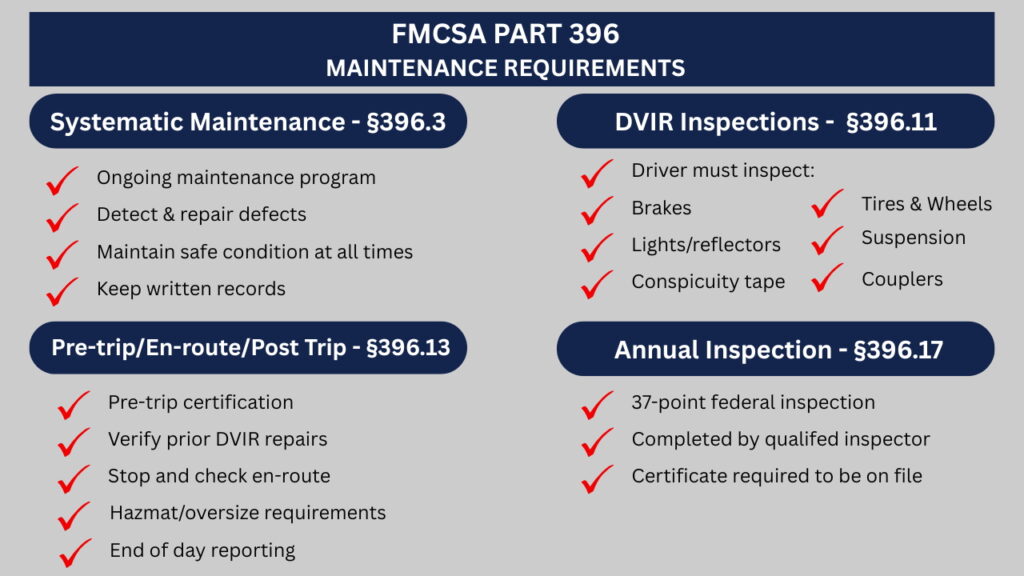
Section 396.3 is the centerpiece of FMCSA’s maintenance rules. It requires every carrier to establish a proactive, continuous maintenance system that ensures each vehicle is safe at all times. This duty applies even when a driver reports “no defects.”
Under §396.3, carriers must:
- Maintain an ongoing inspection and repair system
- Identify defects before they lead to mechanical failure
- Keep the vehicle safe for operation at all times
- Document all repairs, inspections, and maintenance activities
When investigators uncover missing maintenance records, ignored defects, falsified inspections, or patterns of mechanical problems, those findings can frequently establish negligent maintenance under both federal regulations and Georgia law. Such patterns frequently appear alongside broader truck maintenance failures and FMCSA violations across the fleet.
Daily Driver Vehicle Inspection Reports (DVIRs) Required Under §396.11
Under FMCSA §396.11, every commercial truck driver must complete a Daily Driver Vehicle Inspection Report, commonly known as a DVIR, to ensure the truck is safe to drive before it leaves and after it returns.
What Truck Drivers Must Inspect Every Day
A proper DVIR requires the driver to visually and physically inspect the vehicle’s essential safety systems, including:
- Brakes
- Tires and wheels
- Steering components
- Lights and reflectors
- Conspicuity tape
- Suspension
- Coupling devices
Drivers must report any defect that could affect the safe operation of the vehicle. If a defect is noted, the carrier must repair it before the truck is operated on roadways again.
Common Georgia DVIR Violations in Georgia Trucking Operations
Despite the rule, violations of §396.11 are widespread. Some of the most frequent DVIR-related violations seen in Georgia trucking cases include:
- Drivers skipping inspections due to delivery pressure
- Falsified DVIRs
- Signed reports where no inspection occurred
- Missing documentation of defects
- No written proof that required repairs were made
- Carriers relying solely on DVIRs instead of maintaining a true systematic maintenance program
Many of these failures stem from unsupervised safety practices or pressure placed on drivers to meet unrealistic delivery schedules. All of these issues are commonly connected to negligent hiring and inadequate safety supervision within the trucking company itself.
How DVIR Failures Cause Truck Crashes
When DVIRs are skipped, falsified, or ignored, dangerous mechanical defects go undetected. These failures can play a direct role in many of the most serious truck crashes in Georgia:
- Brake fade or out-of-adjustment brakes, reducing stopping power
- Tire blowouts, especially under heavy loads
- Steering drift or sudden steering-component failures
- Multi-vehicle collisions at highway speeds when the driver cannot stop or maneuver
A properly completed DVIR often would have caught these problems long before the truck entered traffic. When it doesn’t happen, the result is often a catastrophic mechanical failure that can harm everyone sharing the roadway.
Pre-Trip, En-Route & Post-Trip Inspections Required Under §396.13
FMCSA §396.13 requires drivers to inspect their vehicles before, during, and after each trip to ensure the truck remains in safe operating condition at every stage of operation. These inspections are separate from the daily DVIR requirements and serve as an additional safeguard to prevent mechanical failures on the road.
Pre-Trip Inspection Duties (Driver Certification Required)
Before a commercial truck can be driven, the driver must complete a thorough pre-trip inspection and certify in writing that the vehicle is safe to operate. This certification requires the driver to:
- Verify the truck is safe to move
- Confirm that any defects listed in the prior DVIR were repaired
- Sign the inspection certification acknowledging responsibility
The pre-trip inspection is intended to be a meaningful review, not a quick walk-around. A driver cannot legally begin a trip without ensuring that any safety issues documented the day before have been corrected.
En-Route Inspection Duties
Drivers are also required to conduct inspections while the truck is in operation, especially during long hauls across Georgia’s interstate corridors. En-route inspection obligations include:
- Required stop-and-checks at appropriate intervals
- Cargo securement re-checks, which work alongside the requirements of FMCSA §393 and help prevent improper cargo loading or securement issues that frequently contribute to serious truck crashes.
- Additional checks for hazardous materials, oversized loads, or specialized cargo
These inspections are critical because mechanical components and cargo securement devices can shift, loosen, or degrade during travel, particularly in the heavy commercial traffic common on I-75, I-16, and related Georgia freight routes.
Post-Trip Inspection Duties
At the end of each day’s operation, the driver must conduct a post-trip inspection and document any defects or safety issues. When defects are reported:
- They must be repaired before the truck is dispatched again
- A mechanic must complete and sign the repair documentation
- The next day’s driver must review the report before beginning their pre-trip inspection
The post-trip inspection closes the loop in the inspection cycle and ensures that mechanical defects do not carry over to the next shift.
Common Violations in Georgia
Despite these rules, many Georgia truck accidents reveal widespread violations of §396.13, including:
- Skipped pre-trip certifications
- Drivers failing to verify repairs listed on prior DVIRs
- No review of previous repair orders before beginning operation
- Drivers pressured to ignore or “pass” obvious defects to stay on schedule
In many cases, these failures directly contribute to brake issues, tire failures, steering problems, and other defects that lead to catastrophic crashes.
Annual Inspections Required Under §396.17
In addition to daily and trip-specific inspections, every commercial motor vehicle must undergo a full annual inspection under FMCSA §396.17. This inspection is far more comprehensive than a DVIR or pre-trip check. It serves as a top-to-bottom evaluation of a truck’s mechanical fitness and is intended to prevent long-term or developing commercial truck defects from ever making it onto the road.
What Annual Inspections Must Cover
Annual inspections must follow the 37-point federal inspection checklist set out in Appendix G of the FMCSRs. This requires a qualified truck inspector to examine every major safety component on the vehicle, including:
- Brake systems
- Suspension components
- Steering mechanisms
- Wheels and rims
- Frames and chassis
- Coupling devices
- Lighting and electrical systems
This inspection is designed to identify issues that may not be caught in daily walk-arounds, such as worn steering components, cracked frames, deteriorated suspension parts, or brake-system degradation developing over time.
Qualifications Required for Annual Inspectors
Not just anyone can perform a federal annual inspection. Inspectors must meet FMCSA’s qualification requirements, which include:
- Demonstrated knowledge of brake systems, steering, suspension, and other key components
- Documented evidence of competence, such as training records or relevant certifications
- Experience or formal education in truck repair or maintenance
- Compliance with FMCSA’s inspector qualification standards
Motor carriers are required to keep qualification records for every annual inspector they use. The rules prohibit carriers from relying on untrained warehouse workers, general laborers, or unqualified shop assistants to complete these inspections. Only properly qualified personnel may sign off on the annual federal inspection certificate.
Common Annual Inspection Violations
When serious truck crashes occur in Georgia, investigators often discover that the required annual inspection was either conducted improperly, or never conducted at all. Common violations include:
- Inspectors not certified or lacking evidence of qualification
- Annual inspection documents were re-used from prior years
- Companies “rubber-stamping” inspections without conducting an actual evaluation
- Known defects ignored or marked as satisfactory despite obvious problems
- Missing federal inspection certificates
- No documentation showing the inspector was competent or trained
These violations are powerful evidence of negligent maintenance. A failed or falsified annual inspection often means the trucking company allowed a dangerous mechanical defect, sometimes one that had been present for months, to go unresolved, increasing the risk of a catastrophic crash.
Repair & Maintenance Record Violations Under §396.3
FMCSA §396.3 requires motor carriers to keep detailed, accurate, and complete maintenance records for every commercial vehicle they operate. These records are important in any truck crash investigation, allowing attorneys and experts to determine whether the company complied with federal maintenance standards or whether neglected repairs, ignored defects, or falsified documentation contributed to the collision.
Required Maintenance Records Motor Carriers MUST Keep
Carriers must maintain a complete maintenance history for each tractor, trailer, and combination unit. These records are required to include:
- Repair logs and work orders
- Driver Vehicle Inspection Reports (DVIRs)
- Periodic (annual) inspection certificates
- Brake measurements and documentation of any brake-system repairs
- Repair invoices
- Defect reports and documentation showing when (or if) they were repaired
- Recall notices and proof that recall repairs were completed
- Mechanic signatures, inspection certifications, and mechanic qualification records
Missing or incomplete maintenance records frequently point to deeper problems in a trucking company’s inspection and repair program. It may also implicate evidence spoliation issues if those records were destroyed, altered, or withheld after a crash.
Speak With a Georgia Truck Accident Lawyer About FMCSA Maintenance Violations
FMCSA Part 396 sets the minimum federal standards for inspecting, repairing, and maintaining commercial trucks. When trucking companies ignore those rules, the consequences can often be catastrophic. If you were injured in a Georgia truck accident and suspect that improper inspections, skipped repairs, or maintenance violations played a role, our legal team can help.
The Georgia truck accident attorneys at Brodie Law Group investigate DVIRs, annual inspection records, maintenance logs, and mechanic certifications to determine whether a carrier failed to meet its federal safety obligations.
Contact us today at 478-239-2780 for a free trucking accident consultation. You pay nothing unless we win your case.