Proving a maintenance-related violation in a Georgia truck accident claim requires a detailed investigation into the truck’s inspection, repair, and compliance history under the FMCSA 396 maintenance rules. FMCSA 396 violations rarely appear by accident as they leave a trail of maintenance records, fault codes, missing documents, and inspection failures that experienced attorneys know how to uncover. This post explains the evidence lawyers can obtain and the steps victims should take to preserve critical proof after a commercial trucking accident.
Key Documents Georgia Truck Accident Lawyers Request
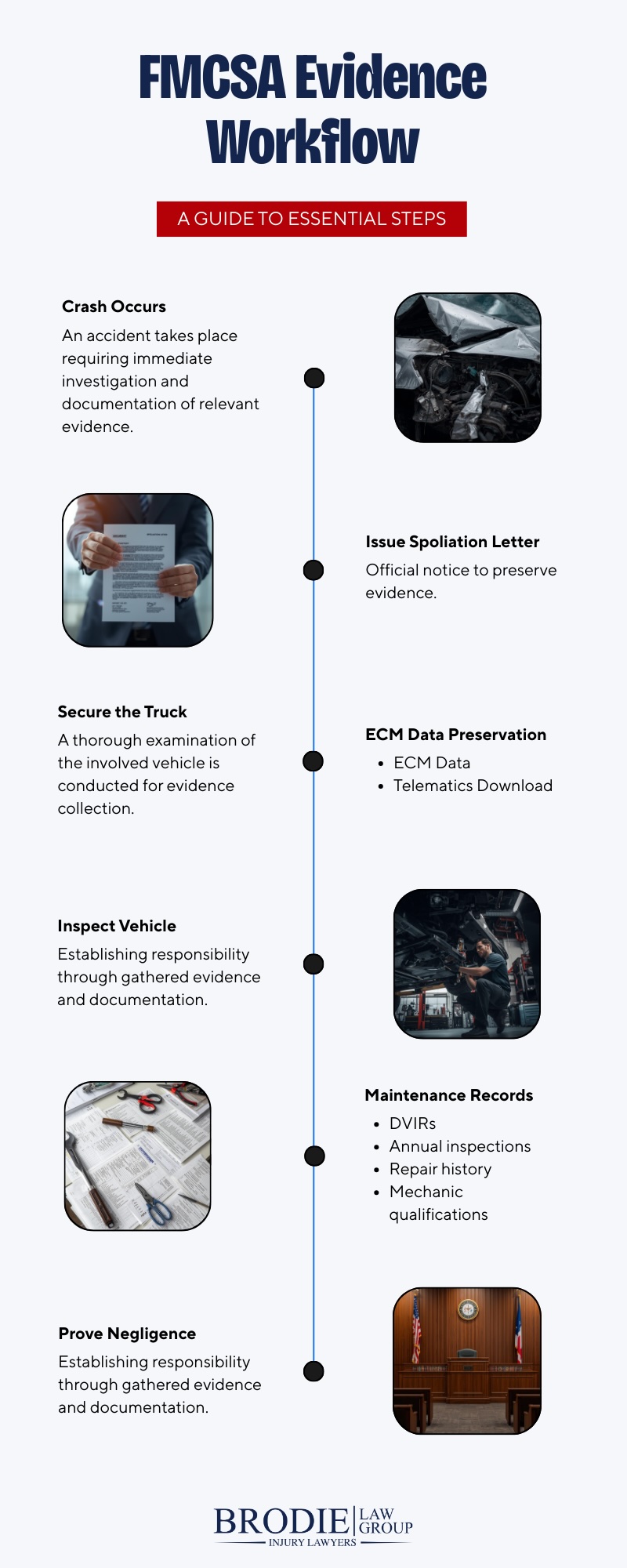
A thorough investigation begins with obtaining every document that reflects the truck’s mechanical condition before the crash. Attorneys typically request:
- Driver Vehicle Inspection Reports (DVIRs)
- Annual and periodic inspection certificates
- Repair orders and work orders
- Brake measurements and related brake-system documentation
- ECM evidence, including fault codes and freeze-frame records
- Pre-trip certifications signed by the driver
- Mechanic and inspector qualification records
These records help reconstruct the truck’s maintenance history, showing what defects existed, when they appeared, and whether the company took the required steps to fix them.
These records help reconstruct the truck’s maintenance history, showing what defects existed, when they appeared, and whether the company took the required steps to fix them. These patterns frequently reveal broader truck maintenance failures that played a role in the crash.
Why Immediate Spoliation Letters Matter in Truck Accident Cases
Trucking companies often act quickly after a crash, and critical records frequently go missing during that time. Federal regulations require carriers to maintain maintenance records for specific retention periods, but those records may be:
- Destroyed early
- Overwritten in electronic systems
- Replaced with revised or “cleaned up” versions
- Lost due to poor internal controls
This is why attorneys immediately send spoliation letters, which demand preservation of all relevant documents and data. These letters trigger serious legal obligations. If records disappear after the carrier receives one, courts may apply the principles outlined in Georgia’s law on evidence spoliation, which can impose adverse consequences on the trucking company.
How Missing Maintenance Records Trigger Spoliation Sanctions
Courts take missing maintenance records seriously, especially when federal retention rules apply. When required maintenance records vanish after a crash, especially after a preservation letter is sent, it can significantly strengthen the injury victim’s case. Courts may impose sanctions when:
- Federal retention rules are violated
- Repair logs or inspection reports are destroyed
- Digital ECM, telematics, or maintenance data is erased or manipulated
- Key documentation (like annual inspections) suddenly cannot be found
If the destruction appears intentional or reckless, the court may instruct the jury to presume the missing evidence would have been harmful to the trucking company. In serious cases, missing maintenance records can also support a claim for punitive damages, especially when the evidence points to a broader pattern consistent with FMCSA 396 violations.
What To Do If You Suspect Maintenance Failures Caused the Crash
Maintenance violations often leave clear signs at the crash scene such as missing lug nuts, uneven tire wear, fluid leaks, mismatched brake measurements, or fault codes on the ECM. But these pieces of evidence disappear quickly, and trucking companies frequently move fast to repair, replace, or remove equipment after a wreck. Taking the right steps early can protect your ability to prove negligence.
Here’s what to do if you believe a maintenance failure played a role in the crash:
1. Seek medical care immediately
Even if injuries are not immediately obvious, crashes involving commercial trucks often cause delayed symptoms. Medical documentation also becomes important evidence in your claim.
2. Photograph the truck and surrounding scene
If it is safe to do so, gather photographs of:
- The truck from multiple angles
- Skid marks or yaw marks
- Tire debris or blown tire fragments
- Leaking fluids
- Damage patterns
- Any parts that appear broken or worn
These images help experts during a Georgia truck accident investigation in identifying mechanical defects.
3. Write down the DOT number and trucking company information
Write down or photograph the truck’s:
- DOT number
- MC number
- Company name on the cab or trailer
- Trailer number
This information allows attorneys to quickly identify the carrier, its safety history, and its FMCSA maintenance records.
4. Request ECM freeze-frame and fault-code data
The truck’s Electronic Control Module (ECM) may contain evidence of:
- Brake applications
- Sudden deceleration
- Fault codes
- Diagnostic alerts
- Engine or brake-system failures
This data can be overwritten or lost within hours if the truck is moved, repaired, or returned to service.
5. Contact a Georgia truck accident lawyer immediately
An experienced attorney can take steps to preserve key evidence such as inspection records, maintenance logs, ECM data, repair histories, and digital fleet-management files before they are lost or destroyed.
Speak With a Georgia Truck Accident Lawyer About FMCSA 396 Evidence and Maintenance Failures
Maintenance violations are among the most preventable causes of catastrophic truck crashes. When a trucking company fails to inspect or repair its vehicles as required under FMCSA Part 396, critical evidence must be preserved quickly before records are altered, overwritten, or destroyed. If you were injured in a collision involving suspected inspection or maintenance failures, legal help is available.
A Georgia truck accident lawyer at Brodie Law Group can immediately begin securing maintenance records, ECM data, inspection histories, and other evidence needed to determine whether FMCSA 396 violations played a role in your crash.
Contact us today at 478-239-2780 for a free consultation. You pay nothing unless we win your case.